


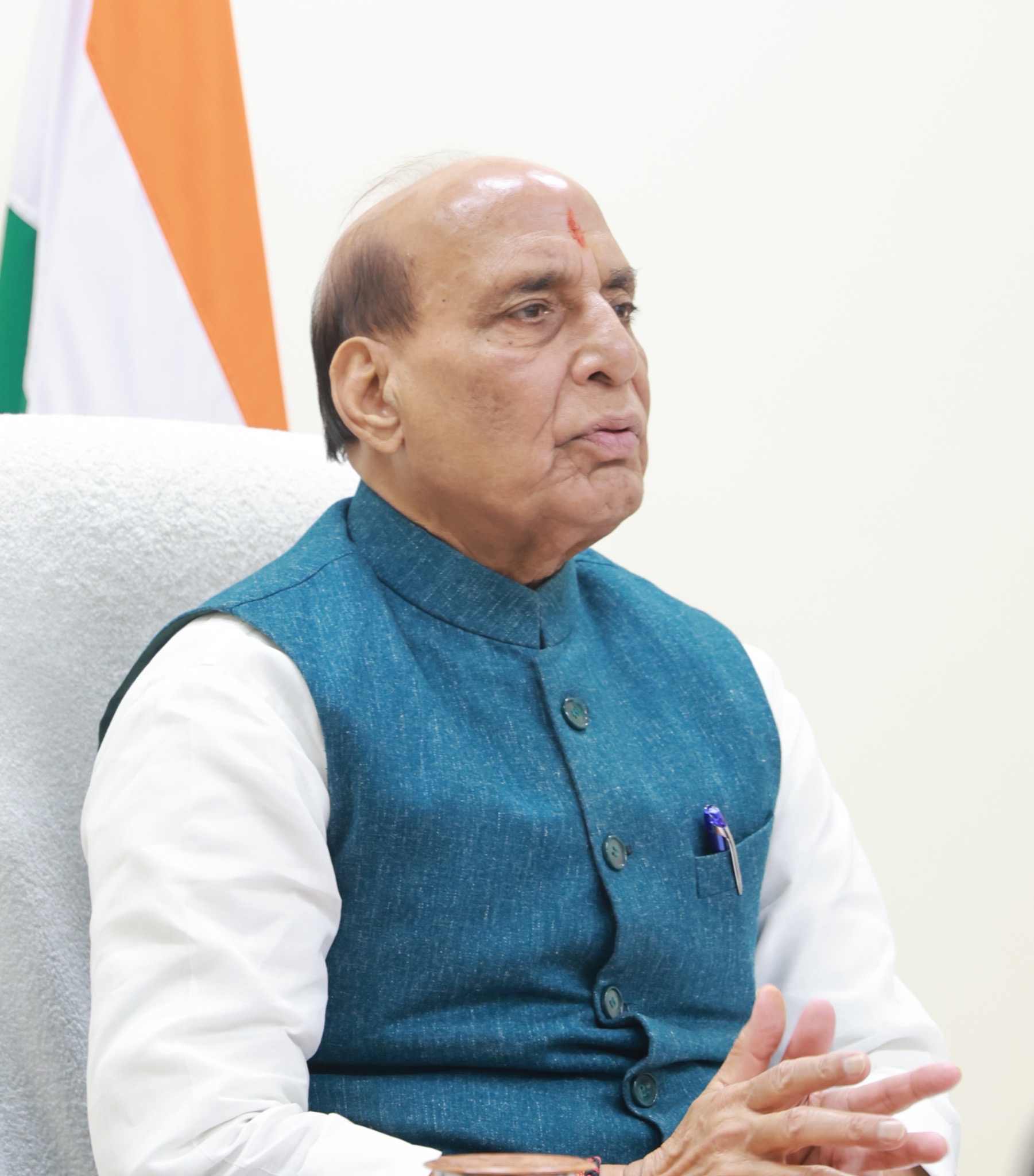
New Delhi, November 15: Defence Minister Rajnath Singh on Sunday called for India to become a developer, innovator and global leader in critical advanced technologies rather than only a user of them, and said the country needs a stronger system for non-destructive testing (NDT) to support defence readiness.
He was addressing, virtually, the 36th annual conference on non-destructive evaluation and enabling technologies and the 15th international symposium on NDT in aerospace. The three-day event is being held in Hyderabad by the Indian Society for Non-Destructive Testing and has brought together more than 2,000 professionals, researchers, defence industry experts and students, according to the Ministry of Defence.
Indigenous inspection capability
Mr Singh said India must build its own capability in advanced inspection techniques, specialised sensors, evaluation tools and related software. He said this would reduce technological dependence and protect critical defence supply chains. He added that public sector undertakings, private manufacturers, startups and micro, small and medium enterprises all have a role in building consistent quality assurance, and that test results must be accurate, reliable and traceable, assessed by qualified professionals. The integrity of results in strategic applications, he said, cannot be compromised.
Why NDT matters for defence
The minister explained that NDT lets engineers check materials, components and structures for internal flaws without damaging them, comparing it to ultrasound and X-rays for the human body. He said hidden defects can affect operational availability, raise maintenance needs, shorten the service life of equipment and, in critical situations, put a mission at risk. He asked the industry to move from finding defects to preventing them by building quality into every stage of manufacturing.
Digital tools and cooperation
Mr Singh said artificial intelligence, machine learning, robotics, advanced sensors, digital twins and predictive analytics are widening what inspection and structural health monitoring can do. He urged India to develop its own solutions instead of only adopting these tools, and said investment in research, equipment, software and skilled people would help Indian technologies find international markets.
He cited progress in missile development, naval platforms, aerospace engineering, radar systems and space applications, and described the commissioning of INS Vikrant, India’s first indigenous aircraft carrier, as a milestone for Aatmanirbhar Bharat. He also said the Innovations for Defence Excellence (iDEX) programme and the Technology Development Fund have encouraged new ideas and development in the sector, and called for a whole-of-government, whole-ecosystem approach.