


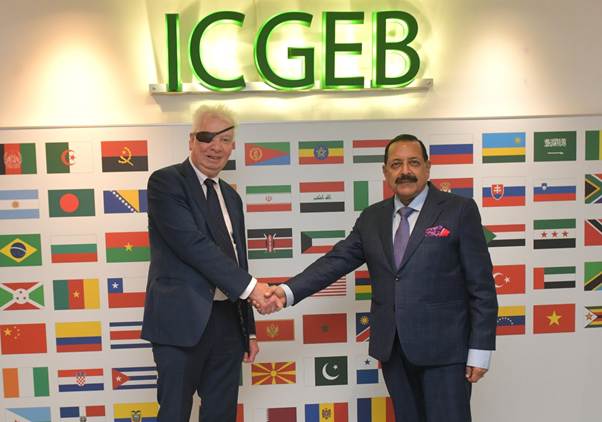
Union Minister of State (Independent Charge) for Science and Technology and Earth Sciences Dr Jitendra Singh visited the Trieste component of the International Centre for Genetic Engineering and Biotechnology (ICGEB) in Italy, where he reviewed research facilities and spoke with the centre’s leadership and Indian researchers.
He was welcomed by ICGEB Director-General Dr Lawrence Banks. Dr Singh toured the biopharmaceutical production and training facility of the Biotechnology Development Unit, the new Biosafety Level 3 laboratory, and the high-throughput screening facility of the Functional Cell Biology laboratory. He also met Indian fellows at the centre and joined them for a working lunch.
India’s work through ICGEB
The visit highlighted the contribution of ICGEB’s India component to the country’s biotechnology research, particularly in areas linked to the BioE3 policy. These included biobased chemicals and enzymes, climate-resilient agriculture, carbon capture and use, precision biotherapeutics, and marine and space biomanufacturing.
Research initiatives presented to the delegation included India’s first biofoundry for microbial biomanufacturing, which Dr Singh inaugurated, work on enzyme and yeast systems for ethanol production, biological carbon capture, genome-edited crops, and monoclonal antibodies against infectious diseases.
About ICGEB
ICGEB is an intergovernmental research organisation with components in Trieste, New Delhi and Cape Town. In India, the Department of Biotechnology supports research and development, innovation incubation and human resource development at the New Delhi component. Its work covers molecular medicine, vaccines, diagnostics, plant biotechnology, bioenergy and genome editing.
Between 2023 and 2026, 67 researchers from 22 countries began or completed training at ICGEB New Delhi, according to the ministry. The centre has also held workshops on artificial intelligence in biology, drug development, genome editing, carbon capture, microscopy and flow cytometry, and works with partners in Asia and Africa on joint research, training and technology transfer.