


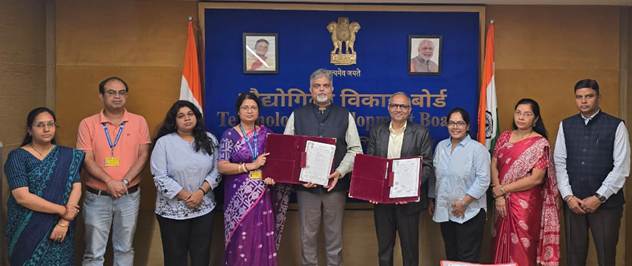
New Delhi, November 12: The Technology Development Board (TDB) will provide ₹64.05 crore to Bengaluru-based Astrome Technologies Pvt Ltd to develop a sovereign, AI-enabled electronic intelligence (AI-ELINT) satellite constellation for national security, the Ministry of Science and Technology said on Thursday.
TDB, which comes under the Department of Science and Technology, has signed an agreement with the company for the support, which will be given through the Research, Development and Innovation (RDI) Fund. The total project cost is ₹128.11 crore.
What the project involves
Under the project, Astrome plans to deploy 50 kg-class AI-ELINT microsatellites in low Earth orbit. Coverage and the frequency with which satellites revisit an area are expected to improve as more satellites are added, supporting persistent surveillance of areas of interest.
The work brings together three components: an ELINT payload, AI-based ground processing software, and inter-satellite communication links. It will cover technology development, engineering, integration, testing and validation.
From lab to deployment
The project aims to take key technologies from Technology Readiness Level 4 (TRL-4) to TRL-9, the stage at which a system is proven in actual operation. Funding is being provided as Optionally Convertible Debt. The project is classified under Deep Technology, with Space Technology as its sub-sector.
What officials said
Rajesh Kumar Pathak, Secretary of the Technology Development Board, said: “Building such complex technology platforms requires sustained innovation, rigorous validation and long-term investment.”
A representative of Astrome Technologies said: “This partnership will support our efforts to advance these technologies towards TRL-9.”
Related: India aims for debris-free space by 2030, says Jitendra Singh at Hyderabad startup facility launch