


New Delhi, November 23: Anaemia is less common in India than previous national surveys suggested, according to key findings of the Indian Council of Medical Research’s SAMPADA survey released on Monday. Severe anaemia was found in less than 2 per cent of people in most age groups, and most cases were mild.
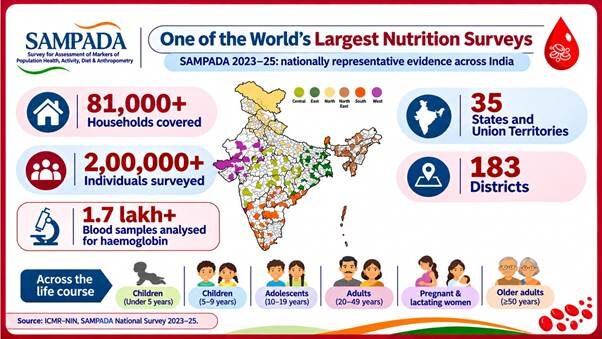
The Survey for Assessment of Markers of Population Health, Activity, Diet and Anthropometry (SAMPADA) 2023-2025 covered more than 2 lakh people from over 81,000 households in 183 districts across 35 states and Union Territories. More than 1.7 lakh blood samples were tested for haemoglobin.
The survey used venous blood samples and automated analysers, which the Health Ministry describes as the gold standard for accuracy. In a sub-sample, it also measured iron status, folate and vitamin B12, along with the inflammation markers C-reactive protein and alpha-1-acid glycoprotein.
Who is affected
- Children aged 12-59 months: 42 per cent
- Adolescent girls aged 10-19: 46 per cent
- Adolescent boys aged 10-19 and men aged 20-59: 22-23 per cent
- Women of reproductive age: 56 per cent
The ministry said the fall compared with earlier surveys was particularly large among young children. SAMPADA also gives national estimates for older adults, a group for which national data has been limited.
Most cases are mild
About half of anaemic women, including pregnant and lactating women, adolescent girls and children, have mild anaemia, which carries a much lower risk of serious health effects than moderate or severe anaemia. Among boys and men, anaemia is much less common, and three-fourths of those affected have only mild anaemia.
Iron deficiency explains about half
Iron deficiency accounts for about half of anaemia in women, adolescent girls and children. The rest is linked to other causes, including infections, inherited blood disorders (haemoglobinopathies) and inflammation from chronic disease. Vitamin B12 and folate deficiency were found at similar levels in people with and without anaemia, which the ministry said shows these deficiencies contribute little to anaemia in India.
Iron deficiency is concentrated among children under five, adolescent girls and women of reproductive age, and is low among boys, men and the elderly. People with moderate or severe anaemia mostly have iron deficiency and need to be identified through testing, treated and tracked until it resolves, as planned under Anaemia Mukt Bharat 2.0.
“It is encouraging that prevalence of anaemia is lower in SAMPADA compared to previous national surveys,” said Dr Rajiv Bahl, Secretary, Department of Health Research and Director General, ICMR.
Dr Bharati Kulkarni, Director, ICMR-National Institute of Nutrition, said the findings support “more targeted, population-specific and life-course approaches to anaemia prevention and management”.
Related: India crosses 1 crore HPV vaccine doses in under nine months; six states reach full coverage
Related: Government health spending up threefold in a decade as out-of-pocket share falls to 42.7%